
Chinese robot startup "outperforms" Nvidia on global AI leaderboard
Spirit AI announced that its Spirit v1.6 embodied intelligence foundation model has become the first model from China to top the global RoboArena leaderboard. As AI gradually enters the real world, the race to develop "robot brains" is becoming a new battlefield between the world's two leading technology powers, according to the South China Morning Post.
A NEW BATTLE IN THE AI SECTOR
Just two days after Nvidia unveiled its Cosmos 3 model, designed to help physical AI systems "think before acting," Spirit AI quickly captured the tech world's attention. On June 4, the Hangzhou-based company (Zhejiang province) announced that its Spirit v1.6 model topped the RoboArena leaderboard with a score of 1,924, surpassing Nvidia's Cosmos3-Nano-Policy, which scored 1,881 to take second place. The third position belongs to DreamZero with 1,763 points, another project from Nvidia announced in February this year.
RoboArena is an evaluation standard co-developed by Nvidia and several leading global research organizations, such as Stanford University and the University of California, Berkeley. This result is particularly noteworthy because RoboArena is designed to measure the efficiency of general-purpose robot control models in converting perception and decision-making into practical actions.
Unlike Large Language Models (LLMs) such as ChatGPT or Gemini, which are built to process and generate text, images, or code, Physical AI is developed to help machines interact directly with the real world. Physical AI is typically built upon two core capabilities: First is "policy capability," the ability of the model to convert observations into specific actions. This is the core criterion used by RoboArena to rank models. Second is "world model capability," the ability to simulate, predict, and reason about what might happen next if a certain action is taken. For many years, these two capabilities were developed separately. However, the new industry trend is to combine them into a single unified architecture.
CHINA "OVERSHADOWS" THE LEADERBOARDS
Last September, Chinese researchers introduced the "World-Policy Model" concept, integrating world simulation and action planning into a single system. This approach is expected to help robots make more accurate decisions in complex and unpredictable environments.
The dominance of Chinese companies extends beyond robot control models. On the WorldArena leaderboard—a standard used to evaluate whether an AI brain is intelligent enough to control robots in the real world—the top spot is currently held by WorldScape-0.2, developed by the Chinese startup Manifold AI.
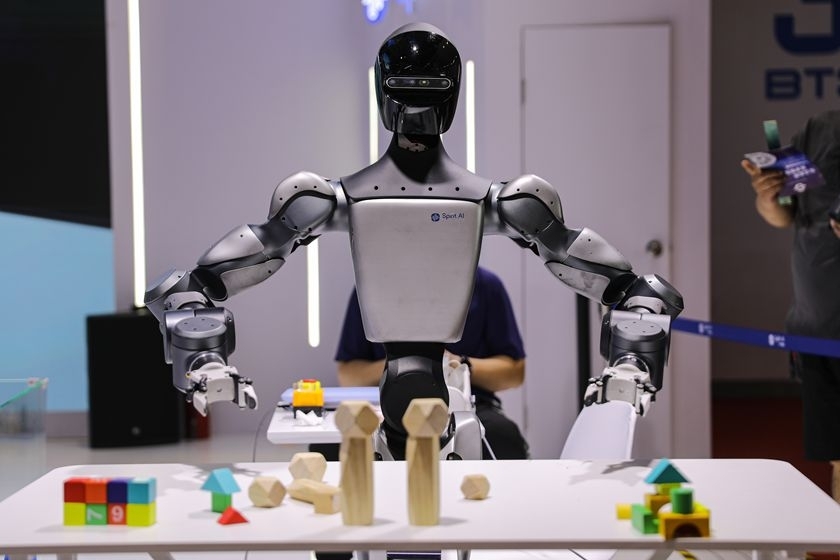
A robot model from Spirit AI - Photo: VCG.
In the field of perception—the factor helping robots observe, understand, and interpret their surroundings—the number one position is currently held by AgiBot, one of China's leading robotics companies. Their model, GenieEnvisioner-Sim2.0-2B, leads the leaderboard thanks to its ability to build simulated worlds from video data for robot control and manipulation tasks, having been announced less than a week ago.
According to Chinese media, the development of China's Physical AI is currently driven by an unprecedented wave of venture capital investment. On June 4, Spirit AI announced the completion of a 1.5 billion yuan (approximately 222 million USD) funding round. This was the company’s fourth funding round in just three months—a speed rare even in the most booming periods of the AI industry.
Another enterprise, XYZ Embodied AI, incubated by the Beijing Institute of Artificial Intelligence, also stated it had just completed a pre-Series A funding round, revealing they raised about 1 billion yuan in just 10 months. Meanwhile, leading startup Manifold AI completed 5 funding rounds in 10 months, with their latest round in April bringing in hundreds of millions of yuan.
Notably, in major tech hubs like Beijing and Shenzhen, local governments have even built state-backed "data factories." These facilities are tasked with collecting, standardizing, and creating massive datasets regarding robot operations in real-world environments.
From vneconomy: https://vneconomy.vn/startup-robot-trung-quoc-vuot-mat-nvidia-tren-bang-xep-hang-ai-toan-cau.htm
Related posts
Tech enterprises create "new competitiveness" for the economy
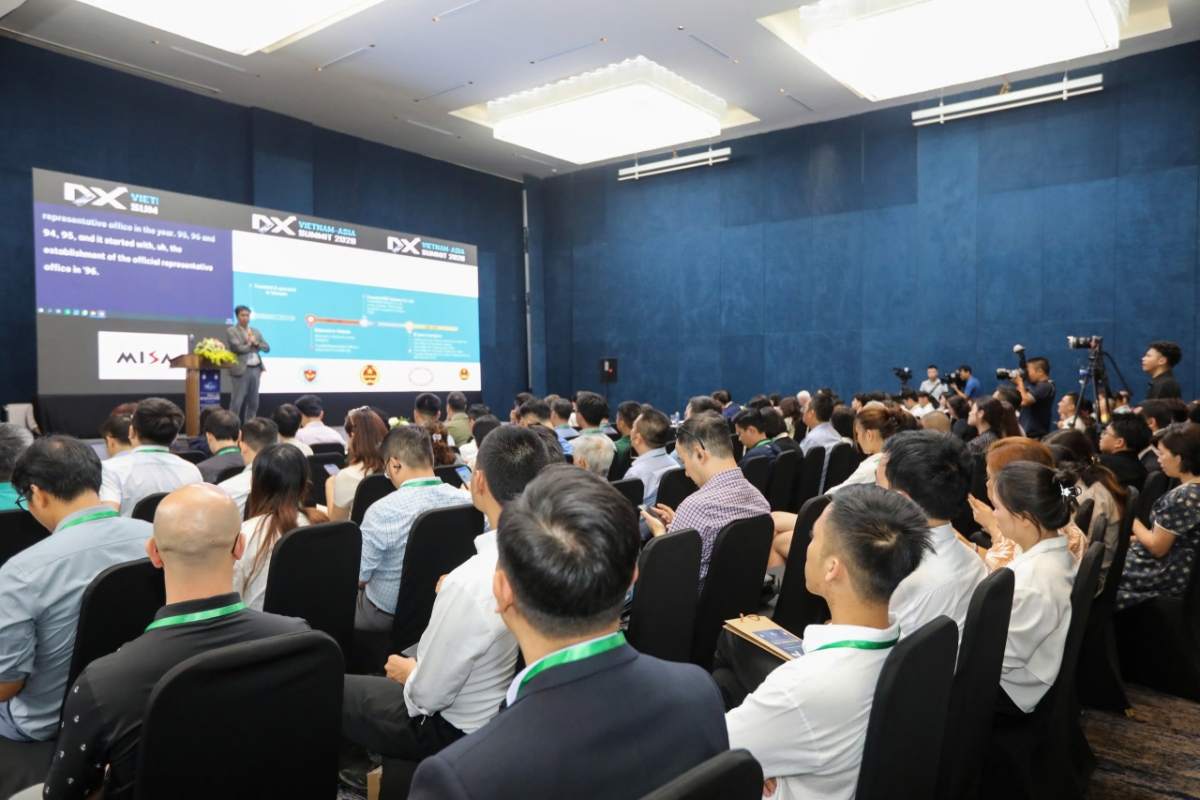
At the Vietnam – Asia DX Summit 2026, experts emphasized that digital technology has become the essential infrastructure for growth and innovation. Aiming for the digital economy to contribute 30% of GDP by 2030, Vietnam is focusing on three pillars: digital government, digital economy, and digital society. The digital technology business community is expected to take a leading role, shifting from outsourcing to mastering technology, and providing AI and data-driven smart solutions to address major national challenges.
Read more
Mechanisms for Vietnam to reach 100,000 technology businesses by 2030
Vietnam aims to develop 100,000 digital technology enterprises by 2030 to promote the digital economy, advance national digital transformation, and enhance value-added contributions within the global supply chain.
Read more