
Mechanisms for Vietnam to reach 100,000 technology businesses by 2030
From providing research support, establishing controlled testing spaces (sandboxes), to creating initial markets..., the digital technology industry development program aims to build a comprehensive ecosystem where Vietnamese enterprises can grow through technology and master it...
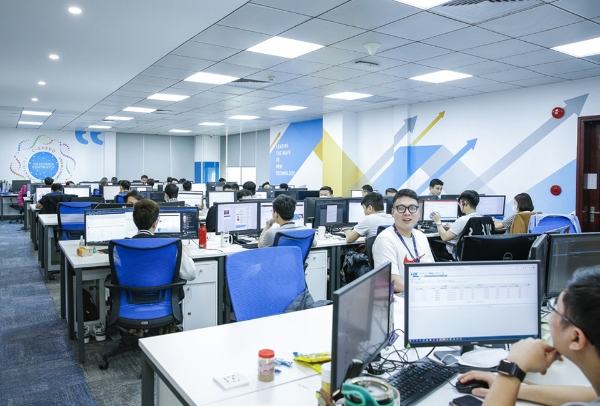
According to Decision No. 840, Vietnam aims to have 100,000 digital technology enterprises by 2030 - Illustrative image.
Decision No. 840/QD-TTg approves the Program for Development of the Digital Technology Industry for the 2026–2030 period, with a vision toward 2045, setting the goal that by 2030, the digital technology industry's revenue will reach at least 300 billion USD. Export revenue from digital technology products and services of Vietnamese enterprises strives to reach at least 55 billion USD annually. Simultaneously, the goal is to reach 100,000 digital technology enterprises.
At the press conference of the Ministry of Science and Technology on June 1st, Mr. Tran Anh Tu, Deputy Director of the Department of Information Technology Industry, stated that within the framework of implementing the program, the focus is not on building many new mechanisms and policies. Over the past time, the Ministry has made efforts to complete the legal framework for the development of science, technology, and the digital technology industry, with many breakthrough policies issued through the Law on Digital Technology Industry, the Law on Science, Technology and Innovation, and related guidance documents.
The program does not deny the role of outsourcing and assembly activities in the process of developing the digital technology industry. However, the long-term goal is to raise the position of Vietnamese technology enterprises in the global value chain, shifting from low value-added stages to higher value-added stages.
"This program mainly puts the already issued mechanisms and policies into practice, creating efficiency in the development of the digital technology industry," Mr. Tu emphasized.
According to Mr. Tu, the program is built on the spirit of "Make in Vietnam," not stopping at the goal of manufacturing in Vietnam, but aiming higher at creating in Vietnam, designing in Vietnam, and mastering in Vietnam.
The ultimate goal is to gradually master technology and develop Vietnamese-branded products and services with competitiveness in the regional and international markets.
Notably, Mr. Tu affirmed: "The program does not deny the role of outsourcing and assembly activities in the development process of the digital technology industry. However, the long-term goal is to raise the position of Vietnamese technology enterprises in the global value chain, shifting from low value-added stages to higher value-added stages such as research, design, manufacturing, standard setting, development of digital technology products and services, and building brands in the market".
Mr. Tu stated that the three major goals of the program—developing the digital technology enterprise force, increasing industry revenue, and forming technology-mastering enterprises—are closely linked to each other.

Mr. Tran Anh Tu, Deputy Director of the Department of Information Technology Industry, Ministry of Science and Technology.
Developing the number of enterprises aims to expand the scale and ecosystem of the digital technology industry; increasing revenue helps expand markets, promote exports, and participate more deeply in the global value chain; meanwhile, the goal of mastering technology focuses on enhancing research capabilities, developing key products, effectively exploiting shared infrastructure, and meeting the standards of major markets.
To realize these goals, the program sets out key tasks.
First is promoting research, development, and innovation. This involves establishing mechanisms to support the development of key digital technology products and services; and encouraging research and controlled testing (sandboxing) for new products and models in accordance with the law, creating a space for enterprises to boldly experiment, create, and refine technology in a suitable environment.
The second group of solutions is creating an initial market and practical problem-solving opportunities for enterprises. According to Mr. Tu, to invest long-term in core technology, enterprises need a market large enough to verify their products. Therefore, the program promotes mechanisms for procurement, task assignments, and public purchasing of key digital technology products and services in accordance with the law, while simultaneously strengthening supply-demand connections and stimulating the technology market.
The third group of solutions focuses on developing substantive capabilities for enterprises. The program supports enterprises in enhancing production capacity, improving product quality, assisting small and medium-sized enterprises in technological innovation to meet domestic and international technical standards, and building a core force of digital technology enterprises.
Alongside this, the program emphasizes the development of shared infrastructure for research, testing, and measurement, such as centralized digital technology parks, laboratories, and centers for evaluating the quality of digital products and services.
Mr. Tu cited the fact that the Ministry of Science and Technology has recently established the Center for Semiconductor Chip Design and Production Support, which currently serves as one of the shared infrastructure facilities for research, testing, and measurement activities in the semiconductor field.
Another important group of solutions is supporting enterprises to participate more deeply in the global value chain. The focus is on helping enterprises meet domestic and international technical standards and regulations to participate in the supply chain, thereby gradually taking on positions with higher added value.
From vneconomy : https://vneconomy.vn/co-che-de-viet-nam-co-100000-doanh-nghiep-cong-nghe-nam-2030.htm
Related posts


Chinese robot startup "outperforms" Nvidia on global AI leaderboard
The race to develop Physical AI has emerged as a new battlefield for tech superpowers. Recently, Chinese startup Spirit AI captured attention by surpassing Nvidia to top the RoboArena leaderboard with its Spirit v1.6 model. Furthermore, other Chinese startups like Manifold AI and AgiBot are currently dominating various global AI rankings. This boom is fueled by unprecedented venture capital investment and strong support from state-backed "data factories" in Chinese tech hubs, which help robots improve their decision-making capabilities in real-world environments.
Read more
Tech enterprises create "new competitiveness" for the economy
At the Vietnam – Asia DX Summit 2026, experts emphasized that digital technology has become the essential infrastructure for growth and innovation. Aiming for the digital economy to contribute 30% of GDP by 2030, Vietnam is focusing on three pillars: digital government, digital economy, and digital society. The digital technology business community is expected to take a leading role, shifting from outsourcing to mastering technology, and providing AI and data-driven smart solutions to address major national challenges.
Read more